
WHAT EUROPE TAUGHT US ABOUT DESIGNING BETTER PHARMACIES IN AUSTRALIA
One trip.
Three countries.
Dozens of pharmacies.
And countless ideas that challenged the way we think about pharmacy design.
Our Senior Designer, Monika, recently travelled through Europe to visit pharmacies across Belgium, Spain and Poland. What she discovered wasn’t a list of trends to copy – it was a different way of thinking about how pharmacy spaces can better support both patients, pharmacists and business outcomes.
In this first of a two-piece content series, Monika shares her insights and learnings.
What Europe Taught Me About Designing Better Pharmacies in Australia
Some of the most valuable design lessons don’t happen in meeting rooms.
They happen when you walk into a space and immediately feel that something simply works.
For me, one of those moments happened while stepping into a small community pharmacy in Belgium.
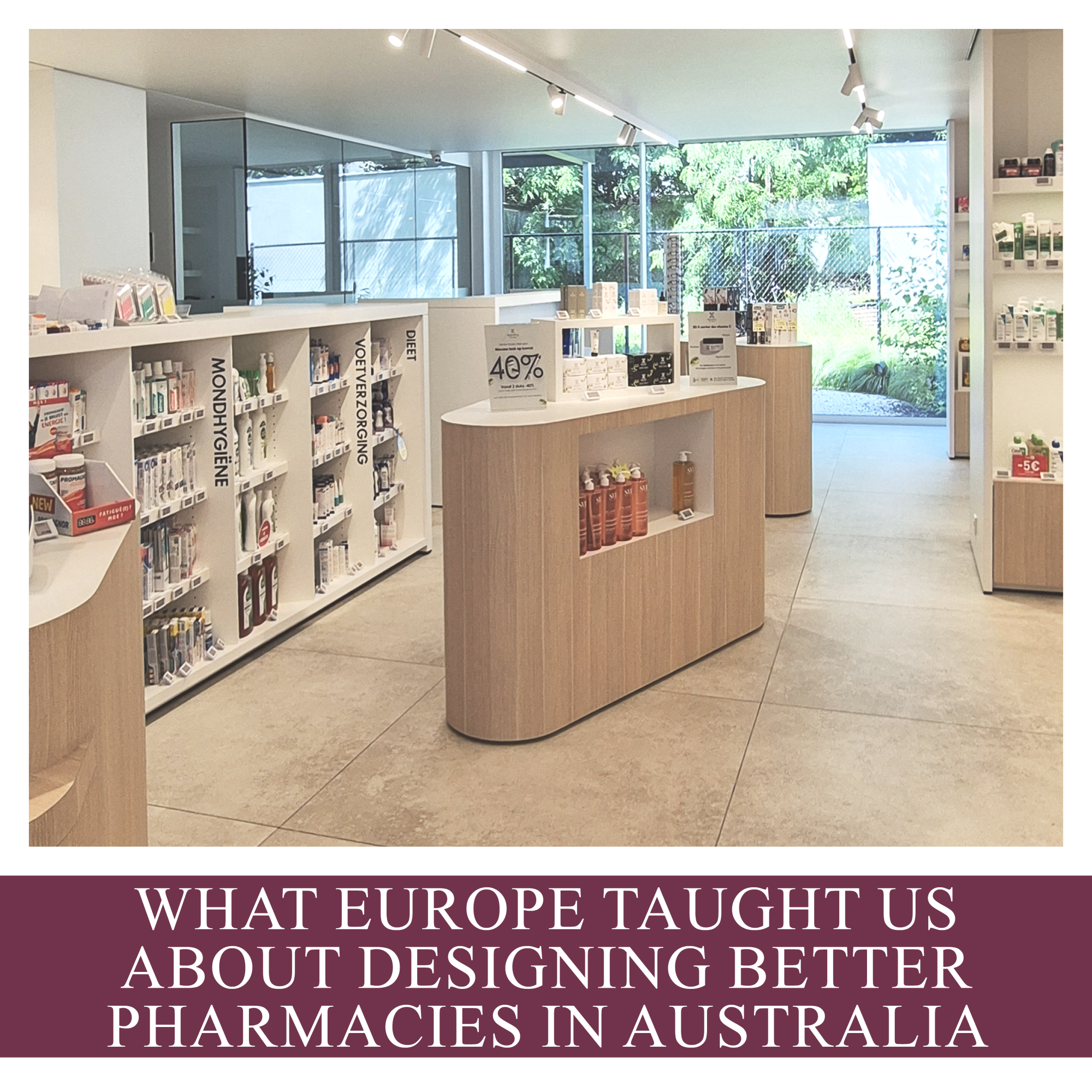
From the street, it looked understated. A clean glass façade, simple signage and no oversized promotional graphics competing for attention. Natural daylight flowed effortlessly through the space, reaching all the way to the rear where another window framed greenery outside. Before a single conversation had taken place, the pharmacy already felt calm, welcoming and reassuring.
Every detail seemed intentional.
That feeling stayed with me long after I left.
Earlier this year, I travelled through Europe, visiting pharmacies across Belgium, Spain and Poland. As Senior Designer at Fusion Health Space, I couldn’t help but look at every pharmacy through a designer’s lens. Every layout, every workflow and every conversation became an opportunity to better understand how different parts of the world are responding to the changing role of community pharmacy.
Some observations reinforced what we already do well in Australia.
Others challenged my thinking.
All of them reminded me that the best ideas come from staying curious.
Looking Beyond Our Own Market
Australian pharmacy design operates within a highly regulated environment. Accessibility requirements, consultation spaces, dispensary workflows and operational standards all play an important role in shaping the way pharmacies are planned.
Those requirements exist for good reason, and in many areas Australia leads the way. Our consultation rooms, for example, often provide a level of privacy, accessibility and functionality that was less common throughout the European pharmacies I visited.
But good design is never about standing still.
Travelling overseas gave me the opportunity to step outside our own market, challenge long-held assumptions and ask better questions.
Could workflows be simpler?
Could customer journeys feel more intuitive?
Could spaces feel calmer, brighter and more welcoming?
Sometimes the answers reinforce what we’re already doing. Sometimes they encourage us to think differently. Either way, the process makes our team better designers.
Different Countries. Different Priorities
One of the biggest observations throughout Belgium, Spain and Poland was how differently pharmacy space is prioritised.
Australian pharmacies often balance healthcare delivery with a significant retail offering, reflecting both our business models and customer expectations. In many of the European pharmacies I visited, however, the emphasis was noticeably different.
Retail was still present, but intentionally restrained.
Instead of long aisles filled with merchandise, many pharmacies featured a carefully curated range of products. The dispensary remained the heart of the business, with pharmacists serving customers directly from the counter and managing most of the prescription journey without requiring patients to move throughout the store.
There were no separate Script In, Direct Dispense and Point of Sale journeys.
Customers approached a pharmacist, discussed their needs, waited while their prescription was prepared, completed payment at the same counter and left.
The experience felt remarkably simple.
That doesn’t necessarily make one approach better than the other.
But it did make me ask an important question.
If the dispensary is where much of a pharmacy’s value is created, does the space allocated to it always reflect its importance?
It’s a conversation worth having, particularly as community pharmacy continues to evolve.
Less Noise. More Purpose
Another lesson wasn’t about workflow.
It was about atmosphere.
Across many of the pharmacies I visited, there was a consistent sense of calm.
Large windows remained uncovered, allowing natural daylight to fill the interiors. Signage was minimal but exceptionally clear. Materials felt warm, timeless and understated. Rather than overwhelming customers with visual clutter, each design decision appeared to make the experience feel simpler and more intuitive.
Perhaps what stood out most was the restraint. Decorative elements were certainly present, but they were used with intention. They introduced warmth and personality without creating visual clutter or distracting from the pharmacy’s primary purpose. Every space still felt first and foremost like a healthcare environment – clear, functional and thoughtfully designed – with just enough character to make it feel welcoming.
Healthcare can already feel stressful.
Whether someone is collecting medication, seeking advice or discussing a sensitive health concern, they often arrive feeling vulnerable.
The environment should help reduce that stress – not add to it.
That small Belgian pharmacy demonstrated something powerful.
Good pharmacy design isn’t only about efficiency.
It’s about creating an environment that helps people feel supported before the conversation even begins.
Automation That Supports Better Care
Automation was another area that stood out.
From robotic dispensing systems to outdoor self-service collection units and other smart technologies, automation was thoughtfully integrated into many pharmacies – not as a replacement for pharmacists, but as a tool to support them.
One feature I noticed, particularly in Belgium, was the use of outdoor self-service medication collection units. Similar in appearance to an ATM, these allowed customers to conveniently collect pre-prepared orders or selected products without entering the pharmacy. More importantly, they weren’t just an interesting concept – I regularly saw people using them, demonstrating how naturally they had become part of everyday pharmacy services.
Inside the pharmacies, one of the most memorable examples was a fully glazed robotic dispensing system positioned behind the counters. I saw a similar approach in a pharmacy in Poland, where the robot was also proudly on display rather than hidden behind walls.
Rather than concealing the technology, these pharmacies made it part of the customer experience. Patients could watch prescriptions moving through the system while pharmacists remained focused on providing care.
It reinforced something I strongly believe.
Automation should never replace the human connection.
It should create more opportunities for meaningful conversations by reducing repetitive tasks behind the scenes while giving patients greater flexibility and convenience.
Bringing Those Lessons Home
Returning to Australia hasn’t meant trying to recreate European pharmacies.
It has meant bringing home a different perspective.
Every project we design at Fusion Health Space is an opportunity to challenge long-standing assumptions.
Do traditional layouts still make sense?
Could natural light play a greater role?
Can customer journeys become simpler?
Is every square metre working as hard as it could?
Can we design spaces that continue to perform well not just on opening day, but for many years to come?
Sometimes the answers confirm what we’re already doing.
Sometimes they encourage us to explore something different.
That’s the value of stepping outside our own market. Innovation doesn’t come from copying what others are doing, it comes from understanding why something works and thoughtfully adapting those ideas to your own environment.
That’s exactly the approach we bring to every pharmacy we design.
Our role isn’t simply to produce plans. It’s to bring the best thinking available – whether it comes from Australia, Europe or anywhere else in the world – and thoughtfully adapt it to Australian regulations, pharmacy operations and the unique goals of every client.